

Today, October 28, 2026, the UN General Assembly approved the 34th resolution since 1992 against the United States embargo on Cuba, with 130 votes in favor, 17 against, and 25 abstentions. 21 countries did not vote. This came after the world saw the Cuban Minister of Foreign Relations at the UN yesterday yelling about an alleged procedural point of order to silence the U.S. Ambassador during the debate on the resolution. Interestingly, nobody recalled any UN votes calling for no sanctions on the apartheid regime of South Africa or the military regimes of Chile and Argentina.
The result reflects a significant decline in support for the resolution, which in 2025 garnered 165 votes in favor, 7 against, and 12 abstentions, and not long ago, only the U.S. and Israel voted against it. The outcome is particularly notable in Latin America, where the U.S. government has staged a decisive comeback to counter Cuba’s threats to regional security and democracy. 5 countries voted against the resolution (Argentina, Colombia, Costa Rica, Ecuador, Paraguay), 6 abstained (Chile, Haiti, Honduras, Jamaica, Peru, and the Dominican Republic), and 3 did not vote (Bolivia, El Salvador, and Venezuela). Only Mexico and Brazil voted in favor.
Despite this significant achievement, much remains to be done for the international community to reject the Cuban dictatorship and support the Cuban people in their pursuit of freedom and the reconstruction of their country.
Let’s focus on Chile
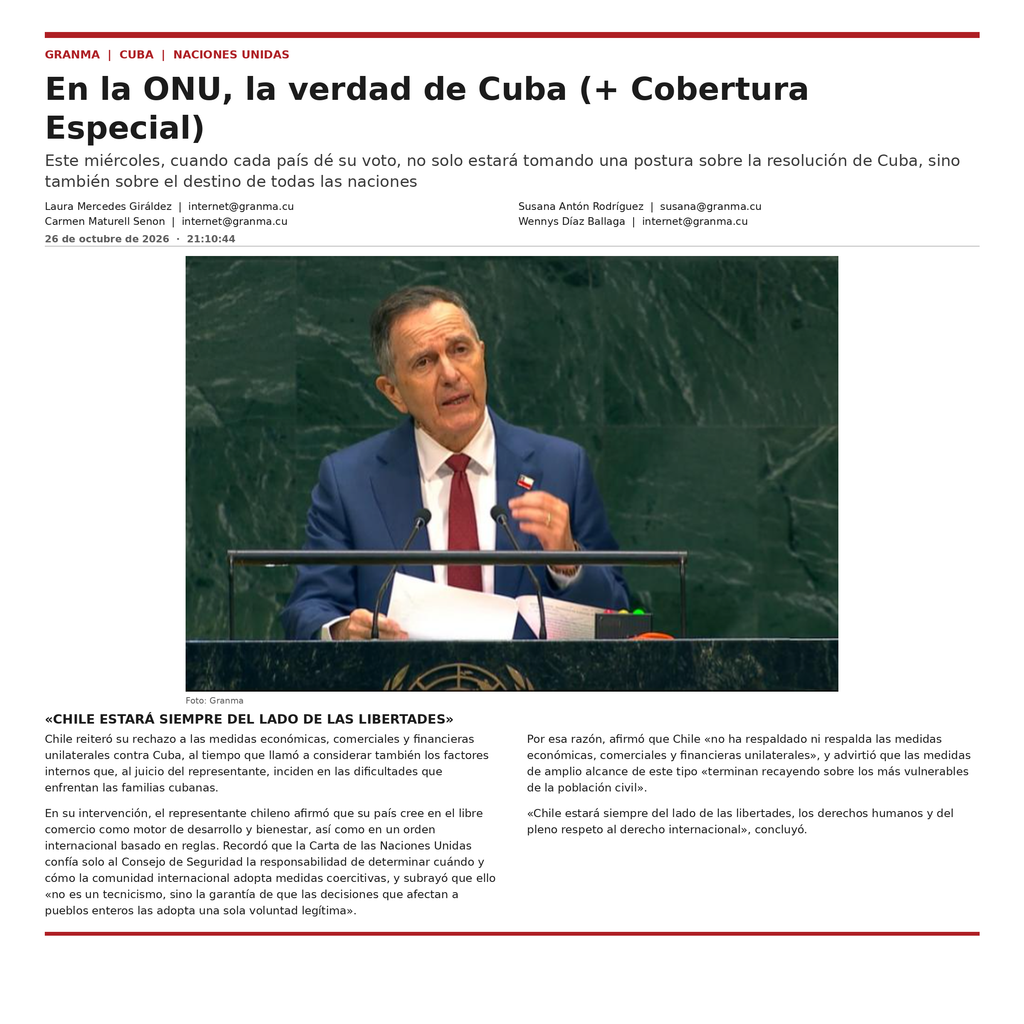
Yesterday, we reported that the right-wing government of Chile would abstain from the vote. Its ambassador, Roberto Ampuero, explained the country’s abstention by saying sanctions fall on the most vulnerable, but thankfully also called for human rights and political reforms in Cuba. Chile’s stance, he said, was based on a rejection of unilateralism (only the UN Security Council can impose multilateral sanctions) and the belief (or presumption) that U.S. sanctions have a (net) negative impact on Cuba’s population. Granma, the official newspaper of Cuba’s Communist Party, quickly used it for propaganda. Earlier today, it included Chile in an extensive collection of remarks from Cuba’s strongest allies and friends denouncing the U.S. at the UN.
Can anyone believe that the UN Security Council, with China and Russia as members, will ever sanction Cuba, or do anything about freedom for its people? Is that what Chile expects?
We don’t blame Ambassador Ampuero for following orders from his president or foreign minister. He knows how the UN works and knows the truth about Cuba firsthand. His book Nuestros Años Verde Olivo (1999) exposes dark secrets from his five years as a young leftist exile living in Havana (1974–1979) and his disenchantment with communism and the Cuban Revolution.
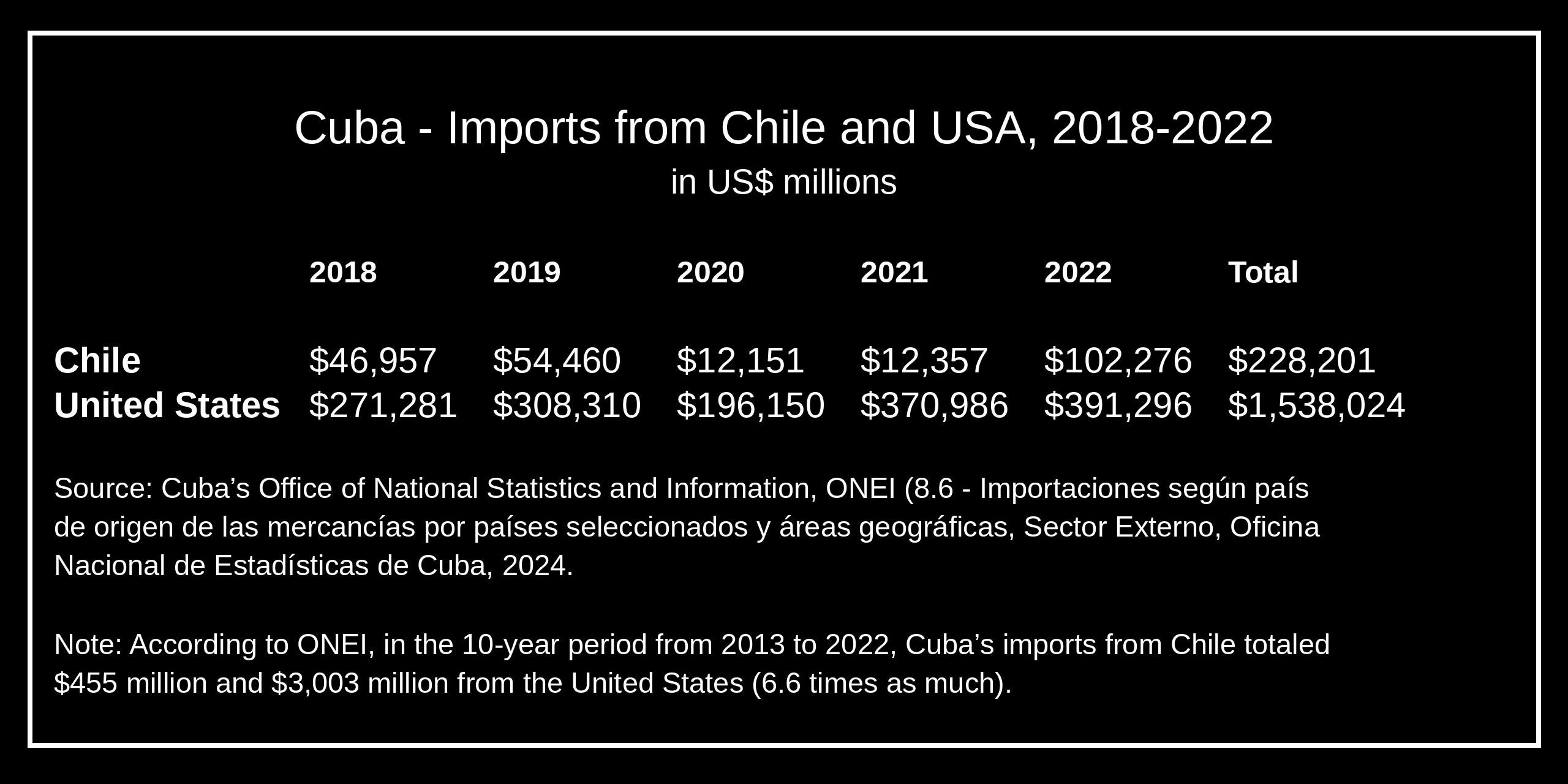
But someone at Chile’s Foreign Ministry must know some basic math. What “coercive” measures is Ampuero referring to? According to Cuba’s very own National Office of Statistics and Information (ONEI), in the five years from 2018 to 2022 (last year reported), Cuba imported $1.5 billion from the U.S., almost seven times more than from Chile ($228.2 million).

Further, in the ten years from 2013 to 2022 (last year reported), the same ONEI reports 27.5 times as many visitors to Cuba from the U.S. (around 9.4 million[1]) as from Chile (343,483).
That’s not even counting remittances and material humanitarian aid that flow to Cuba from the U.S., estimated at many billions of dollars annually.
Chile, moreover, cannot claim ignorance of who’s actually to blame for the suffering of the Cuban people —they well know it’s not because of U.S. sanctions. Many Cubans fleeing the dictatorship have settled in Chile or are trying to. (Chile’s National Migration Service records 19,265 applications for temporary residence from 2014 to June 2024.) They can attest firsthand to the hellhole that Cuba is, thanks to the obstinate imposition by a corrupt elite of a failed model through sheer terror. By the way, we wonder how many Chileans moved to Cuba during the same period?…
Last March, President Kast raised with U.S. President Trump the need to help the Cuban people regain their freedom and used a multilateral forum in Miami to call for countries and international organizations to acknowledge the suffering of the Cuban population for over six decades.
What’s his plan? Here are some ideas.
The Government of Chile could take a leading role in demanding that the UN exert its responsibility to protect the people of Cuba from a totalitarian military regime and jump-start a movement towards long-overdue multilateral sanctions —unless he prefers to lead a multinational force to stage a humanitarian intervention that restores sanity and clears a path to democracy.
Here’s a quick side benefit. Kast would actually be doing something to save Chile from further Cuban interference. For one, Cuba’s Ambassador, Óscar Cornelio Oliva, would lose his job actively spreading Cuba’s dangerous influence all over Chile.
If UN walls had ears
My esteemed colleague and friend Marc Wachtenheim called today to reminisce about an incident we experienced together, courtesy of the Cuban “diplomats” at the UN, err, the regime’s intelligence apparatus there. It illustrates the point we made earlier: that the Cubans have long acted as if they owned the place, and nobody did anything about that until now. Following is Marc’s account.
“Around 2003, when I was a pro-democracy activist, I organized an event on Cuba at UN headquarters in NYC with the UN Correspondents Association. Cuba’s ambassador to the UN sent a letter to the Association’s head ordering him to cancel the event. But the anti-communist Burmese journalist refused —later, Cuba launched an unsuccessful campaign to unseat him.
The Cuban thugs-diplomats followed us around the UN and tried to kick us out of the cafeteria and the building itself. But the UN security guards didn’t cooperate, so we stayed. We met with Senior Adviser to the Secretary General, Alvaro de Soto, on the 33rd floor. Writer and former political prisoner Manuel Vázquez Portal and you [Maria Werlau] spoke at the event.
According to Radio Marti correspondent Carmen María Rodríguez, it was the first time in the many years she had covered the UN that an anti-Castro event took place on UN grounds and that pro-democracy Cubans met with someone so high up in the organization.
Alcibiades Hidalgo, the highest-ranking civilian to defect from the regime, had to pull out at the last minute. He had been threatened, and his daughter still lived in Cuba. Alcibiades had been Cuba’s ambassador to the UN in 1992-93. He told me that he never met, or even saw, over half of the Cuban “diplomats” posted at the UN while he was ambassador. During his first week in the job (he’d been Raul Castro’s chief of staff for 10 years), a Second Secretary in his delegation approached him and told him what his meeting agenda was for the week. Alcibiades responded, “I’m the ambassador, and I’ll decide who I meet.” The “diplomat” told him, “You don’t understand, Ambassador, I work for the Ministry of Interior, and I’m here to tell you what your schedule is.” At that point, he told me he realized he wasn’t really the ambassador.
[1] Assuming, conservatively, that 80% of the diaspora visited from the U.S.
Leave A Comment