

Why is the Cuban regime losing it over U.S. pushback at the United Nations?
Because for decades it has acted as if it owned the place! And the U.S. is finally doing something about it, exposing the Cuban regime’s repression, economic failures, and corruption.
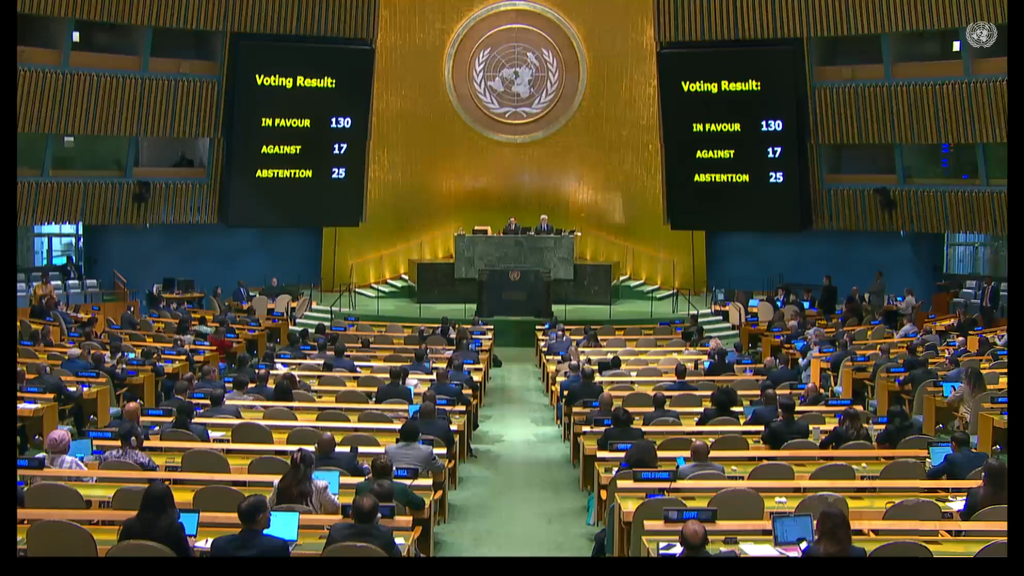
Tomorrow, October 28th, the UN General Assembly will vote on a resolution condemning U.S. sanctions (the embargo) against Cuba. It will be the 34th annual vote on this issue. The non-binding text is symbolic, but the Cuban dictatorship uses it to blame the U.S. for its problems and elicit worldwide support and economic assistance. Since the first resolution in 1992, Cuba Archive has documented 401 extrajudicial executions and forced disappearances, not to mention thousands of political prisoners and millions of exiles, among many more woes.
The mob-like behavior of Cuban “diplomats” toward UN Ambassador Mike Walsh at the UN on October 27th and October 19th is not new. In 2018, several Cuban officials screamed and pounded on desks as OAS Secretary General Luis Almagro spoke at the UN about Cuba’s political prisoners. What’s more, Cuba’s thugs with diplomatic immunity have used violence against human rights defenders in Washington, Geneva, and New York.
The U.S. has expelled Cuban diplomats several times, including three in 1962 who were using the permanent mission to the UN to plan terrorist attacks. According to The New York Times, they intended to “blow up oil refineries in New Jersey, set off incendiary bombs and smoke devices in New York’s major department stores, and throw hand grenades into crowds of Christmas shoppers.”
Cuba Archive’s Executive Director has witnessed Cuba’s entitled misbehaviors at UN headquarters in New York City and at the UN Human Rights Council in Geneva on several occasions. In 2010, the Cuban representative repeatedly interrupted her 4-minute address to the Council, a tactic frequently employed to shout out criticism. In 2013, a presentation by Cuban dissident blogger Yoani Sánchez, coordinated by Cuba Archive with the UN Correspondents Association, was called off after the UN Secretary General, Ban-ki Moon, caved to the Cuban Ambassador’s demands.
As we have reported for years, bankrupt Cuba’s outsized international presence is sustained by a huge apparatus for global propaganda, influence, and expansion. While the vast majority of Cuba’s citizens endure poverty and deprivation —not the outlandishly privileged elite— the regime maintains an inordinate diplomatic footprint. The extensive, and expensive, network includes 126 embassies, 20 consulates, and 25 permanent representations, including the mission to the UN in New York City, staffed with 47 diplomats. This surpasses all countries of Latin America and any country with a comparable population size, including vastly wealthier nations.
Cuba maintains embassies even in many of the smallest and poorest island nations of the Caribbean and Pacific and maintains significant intelligence centers within most embassies to influence countries and recruit spies. It sends doctor-slaves abroad to curry favor with countries it courts for their votes and other favors.
As a result, the Cuban regime has been elected to 21 positions within the UN system: 12 roles in governing or executive bodies, including two vice-presidencies, and nine elected memberships in councils and commissions, including the Human Rights Council, whose mission is “the promotion and protection of all human rights around the globe.” Moreover, the international community, including the strongest democracies, has showered it with impunity, credibility, and unconditional aid.
Yet, Cuba’s so-called diplomats represent a Communist regime with no legitimacy that has for decades hijacked the people’s sovereignty, committed grave and systematic crimes against humanity, insisted on a failed economy, repeatedly threatened global peace and security, spread a dangerous ideology, and left in its wake an enormous cost in lives, suffering, and material devastation in Cuba and across several continents.
No matter what “gains” the UN resolution might show on the side of freedom this October 28th —more abstentions and, perhaps, more votes against it— it is time for the world’s democracies to truly choose between the oppressed Cuban people and their tyrannical regime.
Chile comes to mind, as the spineless right-wing government of José Antonio Kast announced it will abstain from voting on the resolution. Never mind that the US sells goods to Cuba, provides humanitarian assistance, and allows vastly more visitors to travel there than Chile does. Never mind that Chile under Allende nearly fell to an asymmetric occupation by Cuba, as Venezuela did later. Never mind that Chile suffered huge losses in the “spontaneous” attacks against Santiago metro stations and ensuing months of violence, curiously after 8,991 Venezuelans and 1,105 Cubans had entered the country the previous month, and, curiously, after Venezuela’s leaders gleefully celebrated “the bolivarian winds” and successes of the revolutionary plan.
Apparently, the Kast government thinks we should celebrate its abstention. With friends like this, who needs enemies?
We urge Chile and the world’s democracies to start by co-sponsoring the first UN resolution supporting the Cuban people and condemning its repressive regime. They could then join meaningful efforts, with or without the U.S., to help the Cuban people attain their freedom.
P.S. International law establishes that the size of a permanent mission should not exceed what is “reasonable and normal,” taking into account the functions of the organization and the needs of the mission. Isn’t it time to hold Cuba to this bar?
Leave A Comment